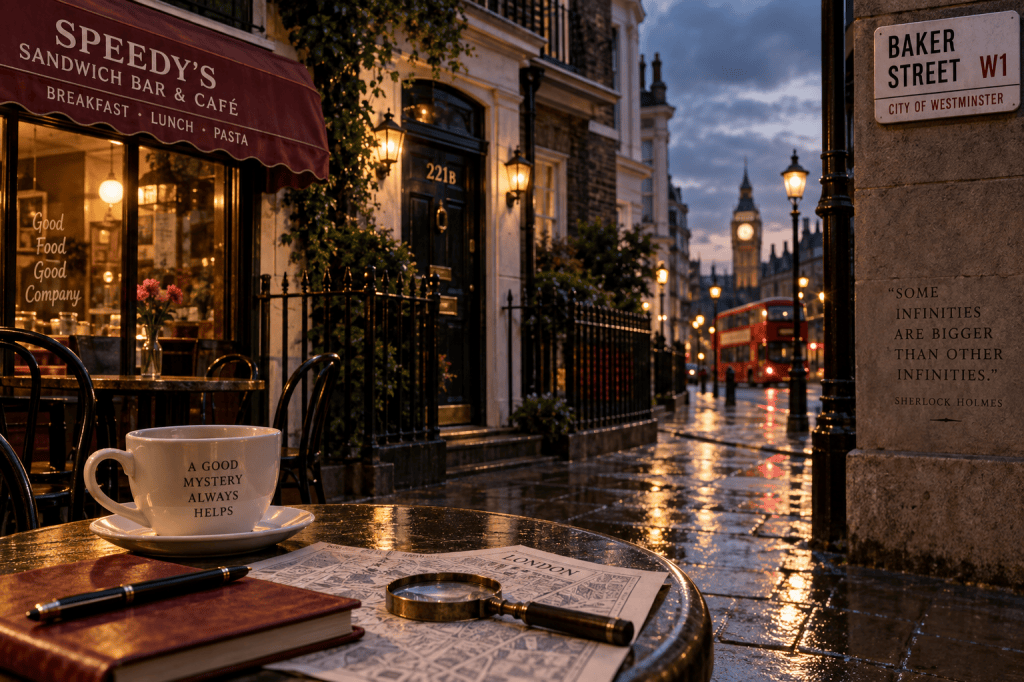
I’ve encountered a lot of fictional detectives over the years. Some I’ve loved, some I’ve liked, and some I’ve probably forgotten almost as quickly as they solved their final case.
But one has always stood above the rest for me: Sherlock Holmes.
Perhaps that’s not particularly surprising for a self-confessed armchair detective.
There’s something fascinating about the way Sherlock’s mind works. He notices the tiny details everyone else overlooks, makes connections that don’t seem to exist and somehow turns an apparently insignificant observation into the clue that solves everything.
He’s also decidedly odd.
Sherlock isn’t necessarily someone you’d choose for an easy friendship. He can be eccentric, difficult and infuriating. But he’s brilliant at what he does and, technically, he’s a sleuth — which makes me like him even more.
And then there’s Watson.
It wouldn’t be Sherlock without Watson
For all Sherlock’s brilliance, the relationship between Holmes and Watson has always been an important part of his appeal for me.
It’s an odd relationship. I’m not entirely sure why Watson puts up with Sherlock half the time, but somehow the partnership works. Watson grounds him, challenges him and provides something Sherlock doesn’t always realise he needs.
That’s something I’ve particularly enjoyed about the modern versions of Sherlock Holmes I’ve watched. Each has given us a different Sherlock, a different Watson and a different interpretation of their relationship.
And somehow I’ve found something to enjoy in all of them.
Benedict Cumberbatch’s modern-day Sherlock
The BBC’s Sherlock brought Holmes into modern-day London, with Benedict Cumberbatch as Sherlock and Martin Freeman as John Watson.
For me, the casting was perfect.
Cumberbatch captured that combination of extraordinary intelligence and complete oddness that I associate with Sherlock, while Freeman’s Watson managed to live alongside him, challenge him and keep him at least vaguely connected to the rest of humanity.
I also loved the way the programme showed us Sherlock’s deductions. Watching his mind race ahead while everyone else was still trying to understand what had happened was part of the fun.
And I enjoyed the series enough that, in 2014, Sherlock took me away from the television and into London.
Following Sherlock to London
We visited Baker Street and 221B, home of the Sherlock Holmes Museum, but I also wanted to see somewhere that had become very familiar from the television series.
The exterior used as Sherlock and John’s Baker Street home isn’t actually on Baker Street. It’s on North Gower Street, beside Speedy’s Café.
So that’s where we went.
And rather than simply standing outside and taking photographs, we went into Speedy’s and had drinks there.
There’s something strange about sitting in an ordinary London café you’ve seen repeatedly on television and then walking outside to see that instantly recognisable doorway beside it.
I took photographs that day as well.
Unfortunately, their whereabouts have since become a mystery of their own.
Perhaps I need Sherlock for that one.
A very different Sherlock in New York
Then there’s Elementary.
This time Sherlock Holmes was played by Jonny Lee Miller, the setting moved to New York and Watson became Dr Joan Watson, played by Lucy Liu.
I’ll admit I wasn’t completely convinced by Joan at first.
She was a very different Watson from the character I was accustomed to, and it took me a while to warm to her.
But I did.
In fact, I grew to love her.
The relationship between Sherlock and Joan became one of my favourite things about Elementary. Joan wasn’t simply Sherlock’s sidekick or someone standing nearby while he did all the clever work. She developed as a detective herself, and their relationship changed and grew with them.
It wasn’t only Sherlock and Joan who made the programme work for me either. Detective Marcus Bell and Captain Thomas Gregson became an important part of the mix. Together, they made a group of characters I genuinely enjoyed spending time with.
And Elementary gave me plenty of time to do that — seven seasons of mysteries and character development.
So which Sherlock wins?
This is difficult.
I love Benedict Cumberbatch as Sherlock Holmes.
I also love Jonny Lee Miller as Sherlock Holmes.
They’re different interpretations, and both work brilliantly in their respective worlds, so I’m quite happy not to choose between them.
Except, apparently, I’m now going to choose between them.
If I absolutely had to pick just one, Jonny Lee Miller would probably win.
Only just.
I think having so many seasons of Elementary helped. There was time for this Sherlock to develop and for his relationships with Joan, Marcus and Gregson to become as important to me as the mysteries themselves.
But I’d happily watch either Sherlock again.
Sherlock on the big screen
I’ve also enjoyed Robert Downey Jr’s rather different interpretation of Holmes in Sherlock Holmes and Sherlock Holmes: A Game of Shadows.
Alongside Jude Law’s Watson, this was another version of the partnership again — bigger, more physical and designed for the cinema, but still recognisably Holmes and Watson underneath it all.
And then there’s Enola Holmes.
Here Sherlock isn’t the main Holmes we’re supposed to be following. The focus moves to his younger sister Enola, giving us yet another way into the Holmes world and another interpretation of Sherlock himself.
I think that’s part of what fascinates me about the character. Sherlock Holmes can move from Victorian London to modern London or New York, be played seriously or with humour, be the central character or move to the sidelines — and somehow he’s still Sherlock.
Sherlock on stage
My Sherlock experiences haven’t been confined to screens either.
In August 2021, I went to the Mercury Theatre in Colchester to see Baskerville, taking one of Holmes’s most famous adventures into yet another medium.
So by this point I’ve watched different Sherlocks on television and film, visited Sherlock-related locations in London, sat drinking in Speedy’s Café and seen a Holmes story performed on stage.
Which brings me to a small confession.
Actually, it’s quite a big one.
There’s just one slight problem…
Considering everything I’ve just written, you might reasonably assume that I’ve spent years reading Arthur Conan Doyle’s original Sherlock Holmes stories.
I haven’t.
The only original Conan Doyle Sherlock I’ve read is The Sign of the Four, and even that was because I studied it as part of one of my degree modules.
It gets worse.
Sitting on my own bookcase is The Complete Illustrated Short Stories of Sherlock Holmes. It’s a huge collection containing all 56 short stories, complete with the original illustrations from The Strand Magazine.
And I haven’t read a single one of them.
I’ve watched Sherlock.
I’ve watched Elementary.
I’ve watched the Robert Downey Jr films and Enola Holmes.
I’ve followed Sherlock to London.
I’ve had drinks at Speedy’s.
I’ve seen Baskerville at the theatre.
Yet sitting on my bookcase are 56 original Sherlock Holmes short stories that I’ve never read.
For a self-confessed armchair detective, that’s quite an omission.
Perhaps it’s finally time I did something about it…